
I took over capital projects procurement for a 180-person hospitality management company in early 2021. That means I handle everything from six-figure renovation orders to LED retrofits nobody wants to talk about. In 2023, I managed roughly $1.2 million in annual spend across about a dozen active vendors, and I report to both operations and the CFO—which means every decision I make has two bosses with different definitions of the word "reasonable."
Normally, my sourcing process is pretty boring. I collect three quotes, compare line items, check references, and make a recommendation. Hotel fixtures, restaurant equipment, the occasional custom millwork order—it's a pattern I know well after three years.
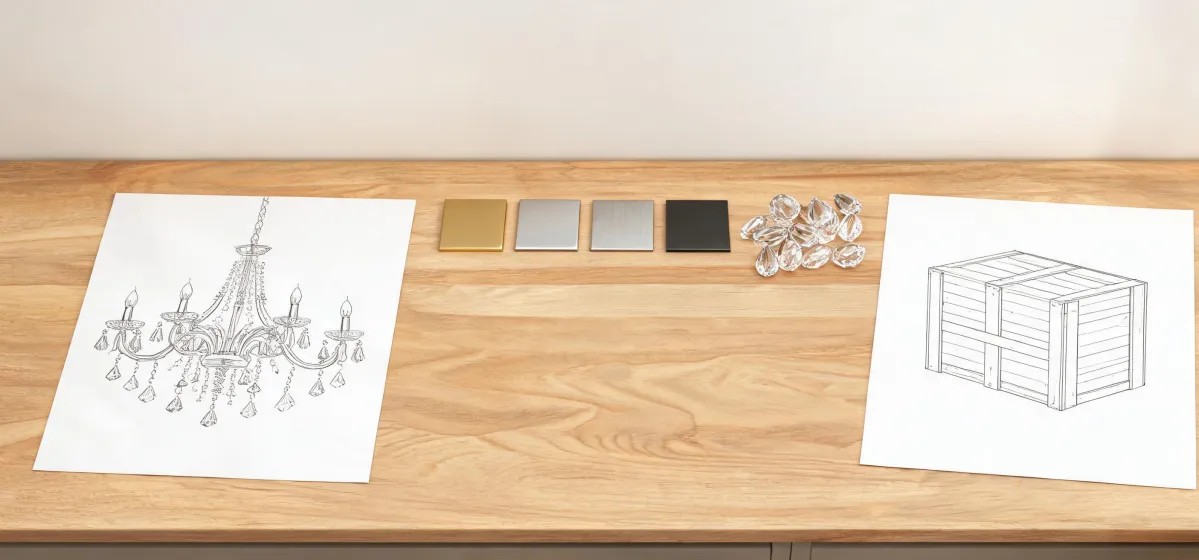
In August 2023, our design team handed me a scope I still think about. Six custom chandeliers for a boutique hotel renovation—two oversized statement pieces for the lobby, four smaller fixtures for the restaurant. All bespoke, all needing to match a brass-and-glass aesthetic the designer had sketched out on a napkin that had somehow already been approved by ownership. Lobby installation was scheduled for January 2024.
I'd sourced standard commercial chandelier lighting fixtures before. This was different. I didn't know it yet, but I was about to make three assumptions that nearly cost us the timeline.
The vendor who promised everything
My first move was the obvious one: I called the lighting contractor we'd used for smaller projects. They'd been fine on standard orders. On the phone, their rep told me they could handle it—design, fabrication, sourcing, installation, everything. "We do this all the time," she said. "Hotel chandelier work is kind of our thing."
Here's the question everyone asks when they call a custom chandelier vendor: "Can you do custom?" The question they should ask is: "What part of custom do you actually manufacture, and what part do you subcontract?"
That's the outsider blindspot I walked straight into. I thought "custom chandelier" was one service. It's actually four or five: design collaboration, engineering drawings, fabrication (metalwork, glasswork, wiring), and UL or ETL listing for commercial installation. A vendor who "does custom" might do exactly one of those and coordinate the rest.
The assumption that cost me six weeks
For three weeks, things moved. They sent CAD drawings. They sent a quote that seemed in the ballpark—about $47,000 for all six pieces, before freight and install. I remember thinking it was lower than I expected, though I might be misremembering the exact number. What I do remember is that the quote didn't include mockups, and it didn't include third-party certification.
"We can get those later," the rep told me. "Once we lock the design."
That was the assumption that cost us time. I assumed "lock the design" meant we were close to fabrication. It didn't. Once we signed the design approval, the vendor walked us through how their process actually worked—none of it dishonest, just a different definition of "custom" than the one I'd been carrying in my head. Fabrication required a 50% production deposit. The lead time shifted from eight weeks to fourteen. The mockup process, which hadn't appeared in the original quote, would add another three weeks on top.
"Custom" means different things at different vendors. At some, it means "we'll modify a stock fixture." At others, it means "we'll build from scratch, and that process includes steps you haven't budgeted for."
Six weeks was the gap between what I'd planned and what was now actually on the table. With a January install date, that put us in mid-February before the lobby fixtures would even ship.
The deal I almost made
I went back to the market. This is where I should mention something that's changed in the last several years. Ten years ago, "local is always faster" was mostly true for custom fabrication, because cross-border collaboration on design drawings was slow and piecemeal. Today, with shared CAD environments and remote sample review, a well-organized overseas supplier can often move faster than a disorganized local one. That legacy belief nearly steered me wrong in the other direction.
I found two viable options. Option A was a domestic custom chandelier manufacturer in North Carolina with a 10-week lead time and a quote of $62,000. Option B was a supplier in Shenzhen with a 7-week lead time and a quote of $41,000. Every spreadsheet analysis said go with B. The savings were real—roughly 34% lower, and the timeline was better on paper.
My gut said something was off. The Shenzhen project manager was responsive but vague about certification—specifically, whether their fixtures would ship with UL or ETL listing, which the U.S. requires for commercial installation (UL 1598 is the underlying standard for luminaires). This wasn't a nice-to-have. It was a deal-breaker. No local electrical inspector signs off on a hotel lobby installation without that listing, and re-certifying after delivery would've eaten every dollar we saved.
I went back and forth between the two for about eleven days. On paper, B made sense. My gut kept flagging that certification answer that never quite answered the question.
What the specialist told me
I called the North Carolina shop back. Their lead told me something I didn't expect: "We do the metalwork and assembly in-house. Glass we outsource to a partner in Ohio. For wiring and ETL listing, we work with a certified shop in Charlotte—we don't do that part ourselves."
She then told me what they weren't good at: "We're not the right fit if you need complex electronics—dimmable LED arrays beyond a certain spec, or smart controls. For this project, though, you're fine."
That admission did more for my confidence than any pitch ever could. If you've ever dealt with a vendor who claims to do everything, you know exactly what I mean. The one who tells you where their boundaries are is the one who's actually thought about where yours are.
We signed with the North Carolina shop. The bespoke chandeliers installed in the first week of January 2024—four days ahead of schedule, which I'm still mentioning in quarterly reports because I never expect it to happen again. The fixtures passed electrical inspection without a single note.
What I'd do differently
Nothing dramatic. I'd ask three questions before signing anything on a custom chandelier project:
- What's included in the quote, line by line? Mockups, revisions, freight, certification, install hardware—each one is a line item, and each one has a number attached.
- Who manufactures what? If the answer is "we coordinate everything," I want names. Who does the glass? Who does the ETL work? Where is it fabricated?
- What aren't you good at? The answer tells you more than any brochure. A specialist who can name their limits is a specialist who's been tested.
That said, I should note my context: we had a designer with a clear vision, a fixed install date, and a project that mattered to ownership. If your Custom Chandeliers Sourcing process is more open-ended, some of this might not apply. But the core lesson will.
The difference between the $47,000 quote and the $62,000 one wasn't the fixture. It was the process. And once I stopped assuming every vendor meant the same thing by "custom," the whole thing started making sense.
Take it from someone who burned six weeks learning it: don't assume the all-in-one vendor is doing everything well. Sometimes the vendor who tells you what they don't do is the one who'll actually deliver.
